
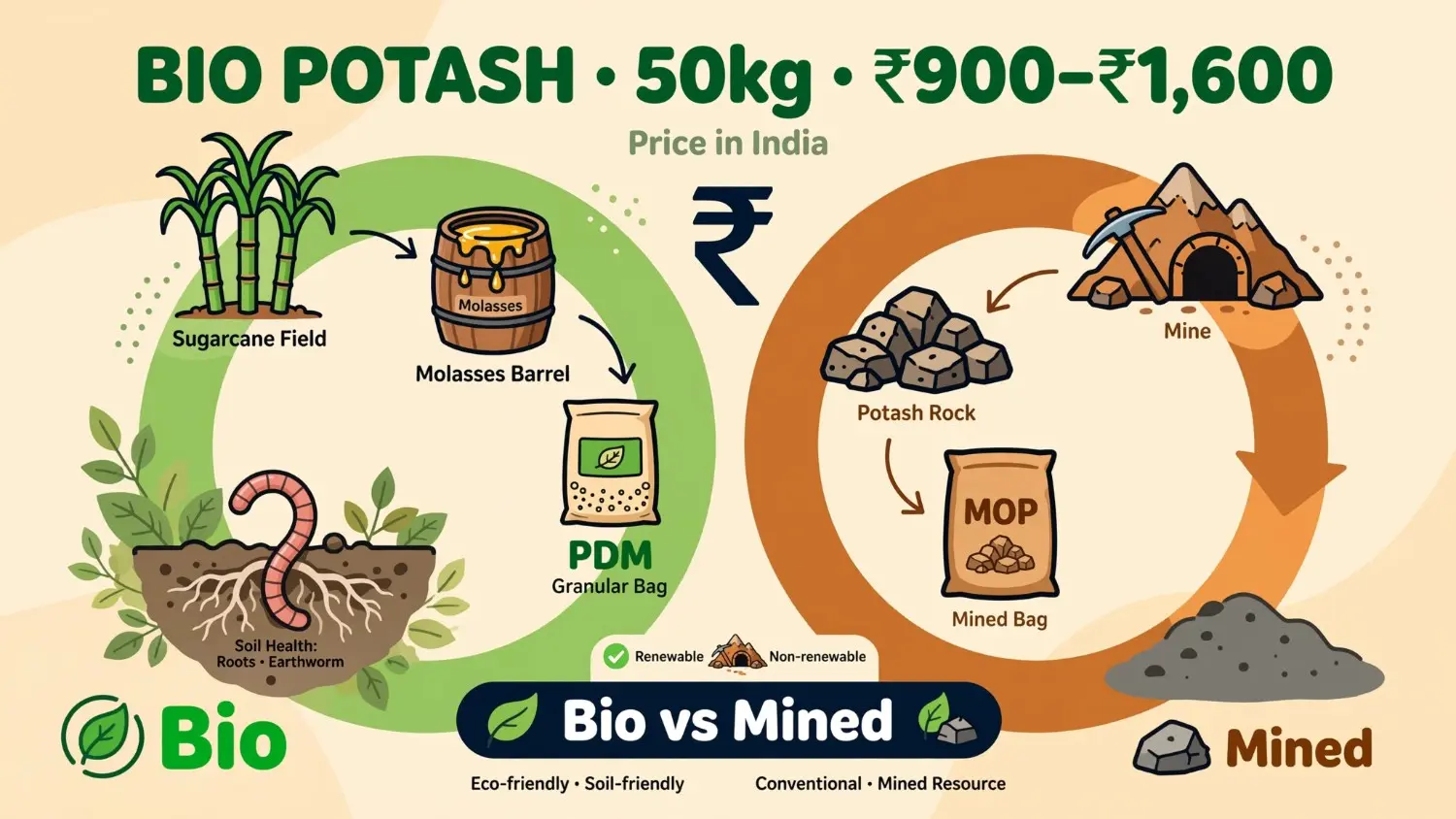
The bio potash 50 kg price in India typically ranges between ₹900 and ₹1,600 per bag, depending on the brand, molasses quality, and region of purchase. This price reflects Potash Derived from Molasses (PDM), a granular bio-fertilizer made from sugarcane industry waste rather than mined mineral ore. Farmers evaluating this cost should compare it against Muriate of Potash (MOP) rates and factor in soil-health benefits before deciding.
If you have been searching dealer catalogues, WhatsApp groups, and mandi conversations trying to pin down a fair number, you already know the answers vary wildly from one seller to the next. That inconsistency is exactly why this guide exists: to walk you through what a genuine bio potash 50 kg price in India should look like, and why two bags sitting side by side on a shelf can differ in cost by several hundred rupees. For a closer look at how this fertilizer performs once it reaches the field, Uwike’s bio potash fertilizer resources break down the agronomic side in more detail.
Before diving into numbers, it helps to understand exactly what “bio potash” means in the Indian market, since the term gets used loosely and often causes confusion at the point of purchase.
What is Bio Potash (Granules) and Why the Price Varies
Bio potash, in the context most Indian farmers and retailers refer to, is Potash Derived from Molasses (PDM) – a granular soil input manufactured from the fermentation by-products of sugarcane processing. Unlike Muriate of Potash (MOP), which is mined from mineral deposits, PDM is produced through a bio-industrial process that converts molasses waste into a potassium-rich granule.
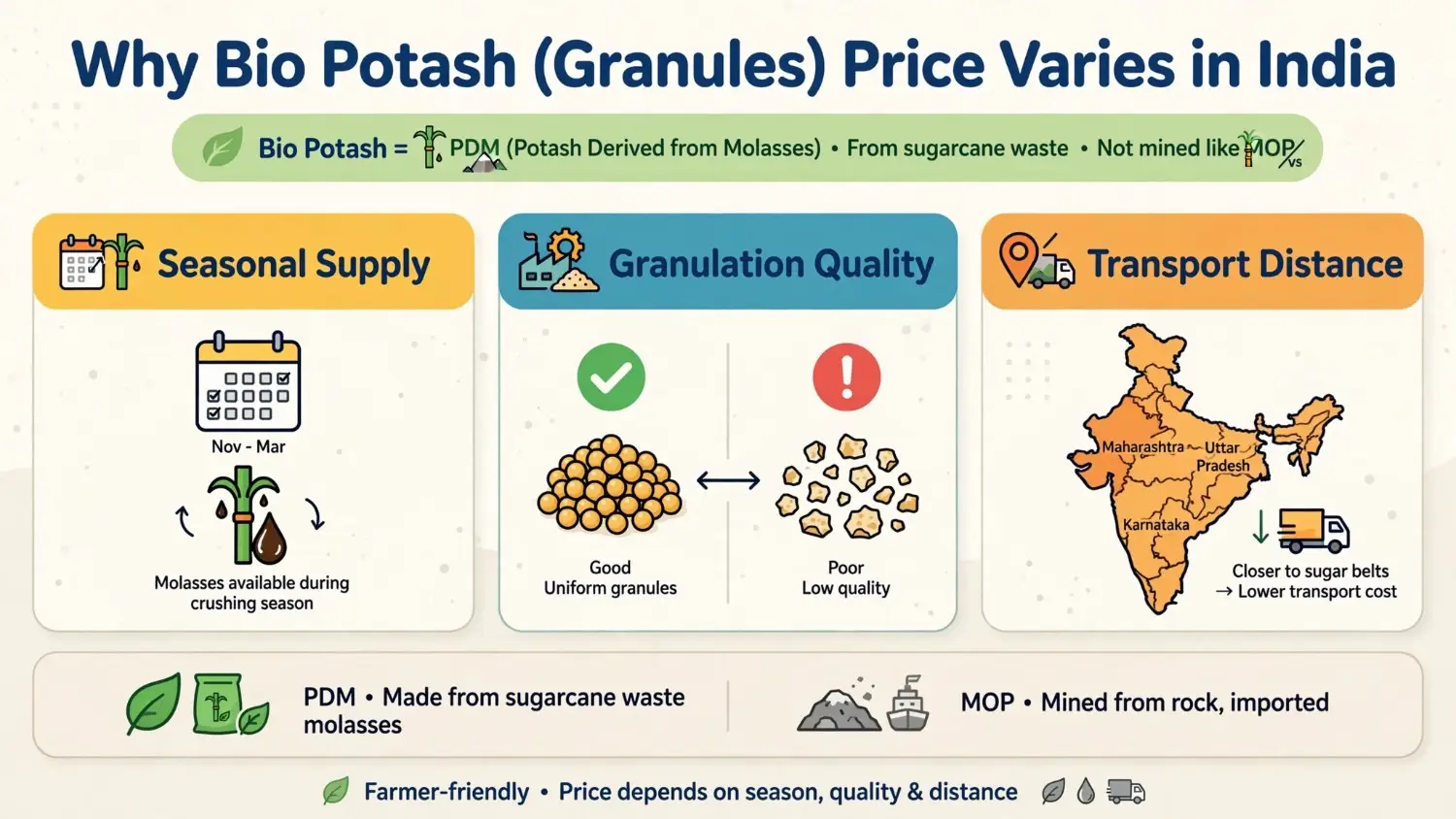
Because of this manufacturing difference, pricing behaves differently too:
- Raw material sourcing shifts with sugarcane crushing seasons, since molasses availability is tied to sugar mill output.
- Granulation quality varies between manufacturers, affecting both cost and field performance.
- Regional proximity to sugar belts (Maharashtra, Uttar Pradesh, Karnataka) often means lower transport costs and, in turn, slightly better pricing.
If you want the full technical background on how this product is made and used, Uwike’s detailed guide on potash derived from molasses covers the production chemistry and application logic in depth.
Bio Potash 50 kg Price in India: Current Market Range
Here is a realistic snapshot of what buyers commonly encounter across Indian states. Treat these as indicative ranges rather than fixed figures, since dealer margins and transport distance shift the final number.
| Bag Size | Typical Price Range (₹) | Price Per Kg (₹) | Common Buyer Type |
|---|---|---|---|
| 50 kg (standard granular) | ₹900 – ₹1,200 | ₹18 – ₹24 | Individual farmers, small holdings |
| 50 kg (premium/branded) | ₹1,250 – ₹1,600 | ₹25 – ₹32 | Commercial farms, orchards |
| 50 kg (bulk/wholesale, 10+ bags) | ₹800 – ₹1,050 | ₹16 – ₹21 | FPOs, dealers, cooperatives |
These figures move throughout the year, so a price quoted in the sowing season will rarely match what you see during the off-season lull. Consequently, timing your purchase can matter almost as much as choosing the right brand.
What Affects the Bio Potash 50 kg Price in India
Several distinct variables combine to set the final number on your invoice. Understanding each one lets you spot when a quoted rate is fair versus inflated.
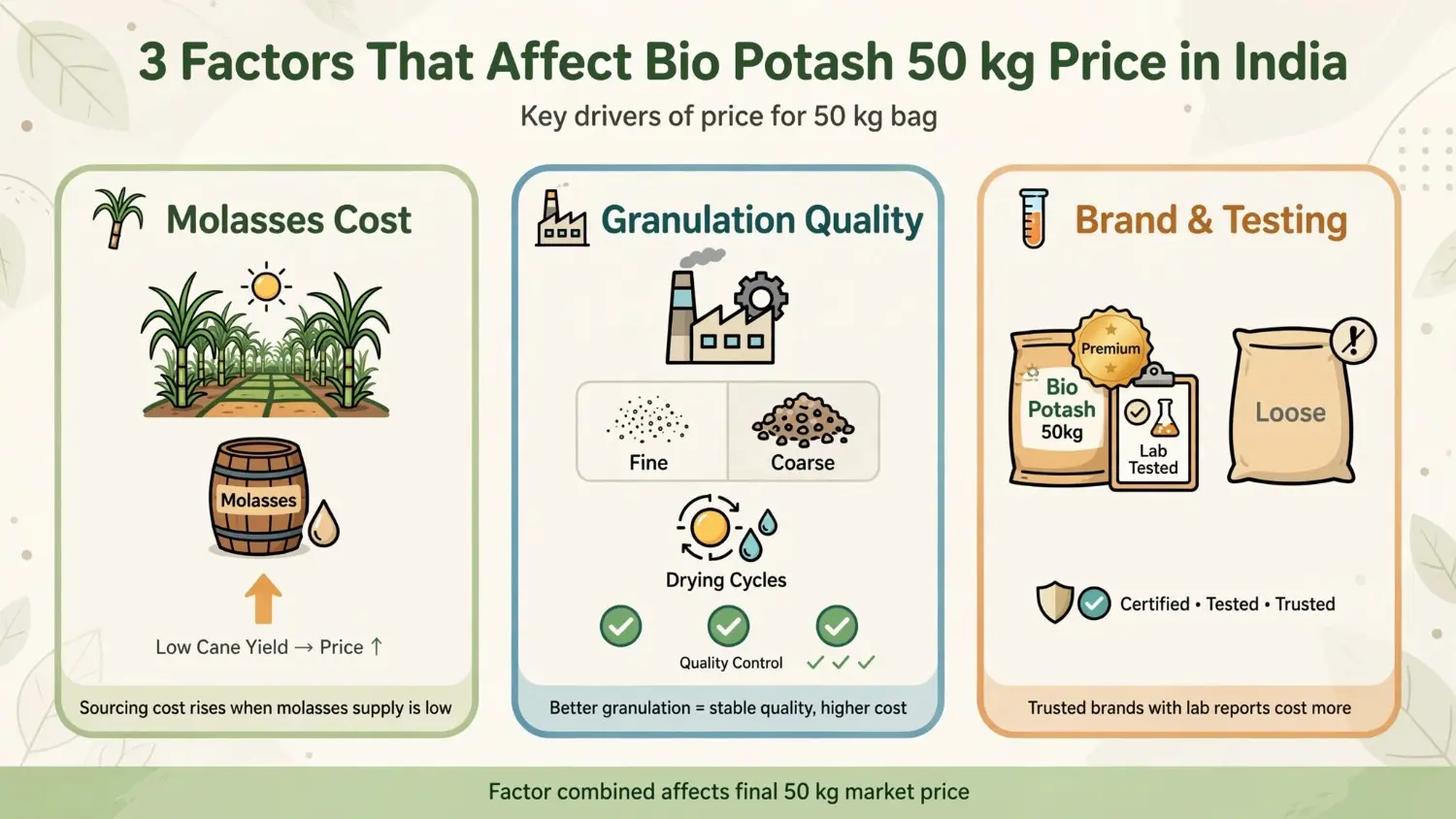
1. Molasses Quality and Sourcing Cost
The starting raw material – molasses from sugar mills – fluctuates in price alongside sugarcane crushing output. In years with lower cane yield, molasses becomes scarcer, and manufacturers pass that increased input cost downstream to the bio potash 50 kg price in India.
2. Manufacturing Process and Granulation Standard
Not every producer granulates to the same specification. Finer, more uniform granules generally require:
- Additional drying cycles
- Tighter quality control
- More precise nutrient blending
These steps raise production cost, which naturally reflects in the retail price.
3. Brand Reputation and Lab Testing
Established brands that publish third-party lab analysis and maintain consistent nutrient content usually price higher than unbranded or loose-sold alternatives. Although this premium can feel steep upfront, it often reduces the risk of buying an under-strength product that performs poorly in the field.
4. Packaging, Transport, and Regional Logistics
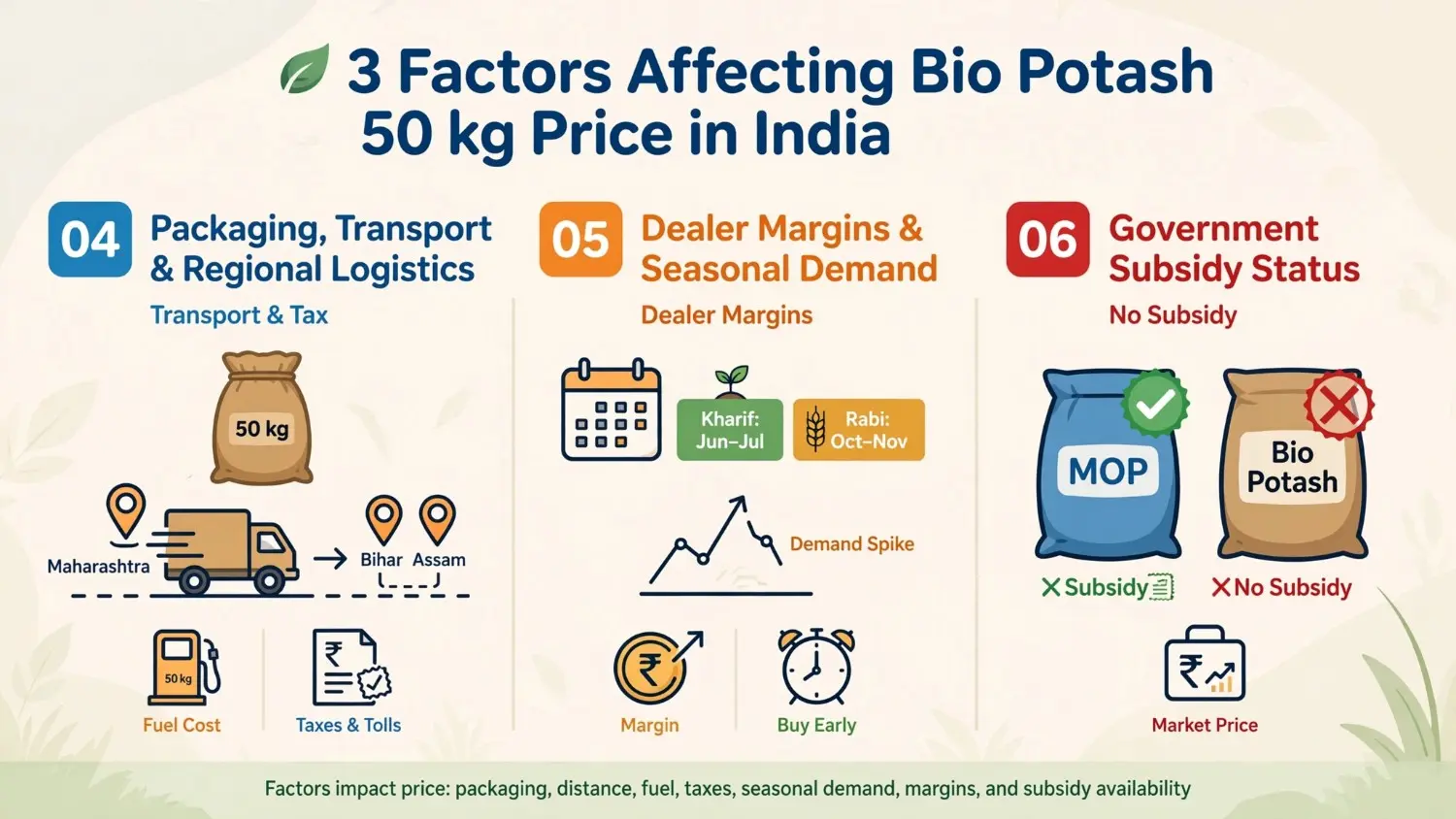
A 50 kg bag manufactured in Maharashtra will typically cost less in Pune than it does after being trucked to a dealer in Bihar or Assam. Freight distance, fuel prices, and state-level taxation all layer onto the base manufacturing cost.
5. Dealer Margins and Seasonal Demand
During peak sowing windows – particularly before the kharif and rabi seasons – demand spikes and some dealers raise margins accordingly. Buying slightly ahead of the rush, when feasible, often secures a better rate.
6. Government Subsidy Status
Unlike chemical fertilizers such as MOP, bio potash generally does not fall under the same subsidy structure. This means its price reflects actual market cost more directly, without a government-controlled ceiling.
For readers who want a broader view of how these granules are used agronomically once purchased, the bio potash granules guide walks through application rates and crop-specific dosing.
Bio Potash vs Chemical Potash (MOP): A Price and Value Comparison
Farmers frequently ask whether the bio potash 50 kg price in India justifies choosing it over conventional Muriate of Potash. The table below lays out the practical differences.
| Parameter | Bio Potash (PDM) | Muriate of Potash (MOP) |
|---|---|---|
| Typical 50 kg price | ₹900 – ₹1,600 | ₹1,700 – ₹1,850 (post-subsidy) |
| Source | Sugarcane molasses by-product | Mined mineral ore |
| Soil impact | Improves organic content, microbial activity | Neutral to soil biology, purely mineral |
| Chloride content | Low to negligible | High (can affect chloride-sensitive crops) |
| Government subsidy | Generally not subsidized | Subsidized under nutrient-based scheme |
| Release pattern | Gradual, soil-friendly | Fast-release, immediate availability |
Notably, while MOP often looks cheaper after subsidy, the chloride load can be a drawback for crops like tobacco, grapes, or certain fruit varieties. Bio potash, meanwhile, tends to suit organic and integrated nutrient management programs where soil health is a long-term priority. To understand how bio potash fits alongside other potassium sources, the Bio K fertilizer explainer offers a useful side-by-side breakdown.
How to Read a Bio Potash Price Quote (Per Kg vs Per Bag)
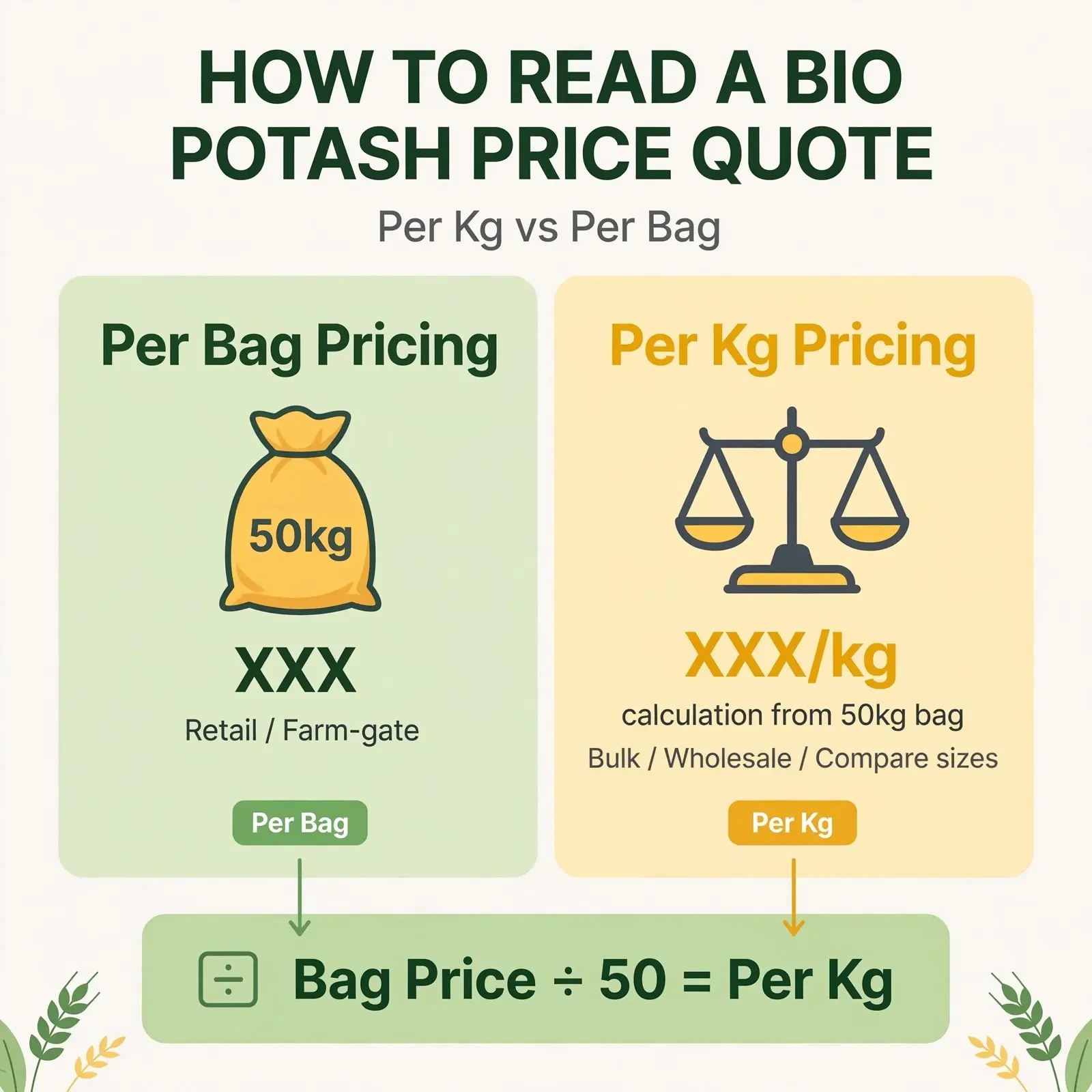
Dealers quote prices in two common formats, and mixing them up leads to confusion at the counter.
Per bag pricing
- the total cost of a full 50 kg unit, most common in retail and farm-gate transactions.
Per kg pricing
- Used mostly in bulk or wholesale deals, and easier for comparing across different bag sizes (25 kg, 40 kg, 50 kg).
Quick way to check fairness: divide the quoted bag price by 50. If the resulting per-kg figure falls outside the ₹16-₹32 range covered earlier, ask the dealer to justify the difference – it may reflect premium testing, or it may simply be an inflated margin.
Common Mistakes Farmers Make When Buying Bio Potash
Even experienced buyers fall into a few recurring traps. Avoiding these can save both money and crop performance.
- Comparing unbranded loose stock to lab-tested branded bags without adjusting expectations on nutrient consistency.
- Buying purely on lowest price, without checking the potassium content percentage printed on the bag.
- Ignoring batch or manufacturing date, since older stock can lose granule integrity.
- Skipping a moisture check – bio potash that feels damp or clumped often indicates poor storage, which affects nutrient release.
- Assuming all “bio potash” products are identical, when formulations and molasses grades genuinely differ between manufacturers.
Expert Tips to Get the Best Bio Potash 50 kg Price in India
- Buy during the off-season (post-harvest lull) when dealer inventory pressure often brings prices down.
- Ask for the lab test certificate before finalizing a bulk order, especially for orders above 10 bags.
- Compare at least three quotes from different dealers or cooperatives before committing.
- Check for FPO or cooperative buying schemes, which frequently negotiate better bulk rates than individual purchases.
- Factor in transport cost separately, since some dealers quote an artificially low bag price but recover margin through inflated delivery charges.
For a foundational overview before making a purchase decision, the complete guide to bio potash fertilizer is a helpful starting point for both home gardeners and full-scale farmers.
Step-by-Step: Verifying a Fair Bio Potash Price Before You Buy
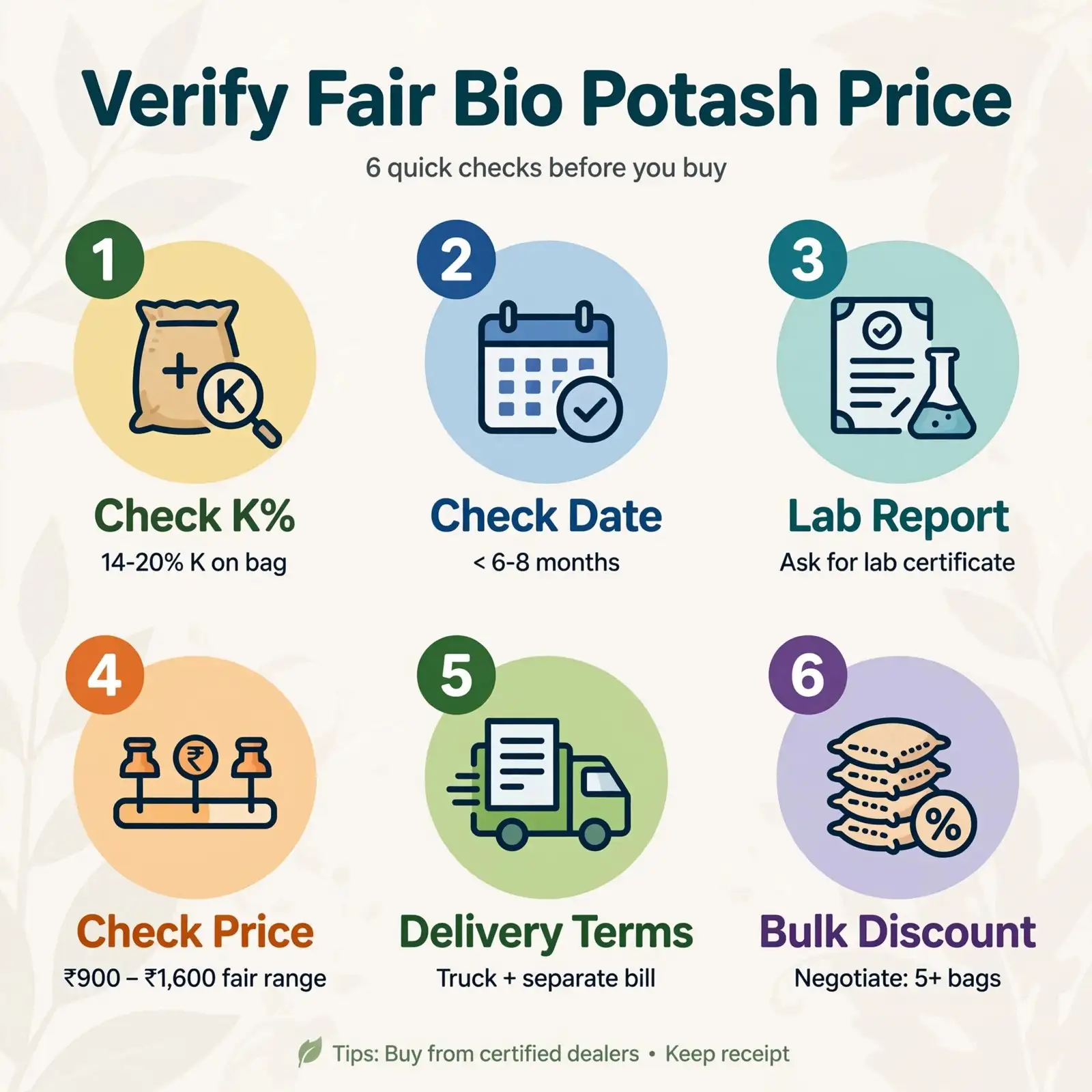
- Check the potassium (K) percentage printed on the bag – most quality PDM products range between 14-20% K.
- Request the manufacturing date and confirm it falls within the last six to eight months.
- Ask for a lab certificate, particularly for orders meant for large acreage.
- Cross-check the quoted price against the ₹900-₹1,600 range discussed earlier.
- Confirm delivery terms separately, since transport charges are sometimes bundled unclearly into the “final” price.
- Negotiate bulk discounts if purchasing more than five bags, which most dealers accommodate readily.
Following this sequence typically prevents the two most common buying regrets: overpaying for an unverified brand, or underpaying for stock that turns out understrength.
Regional Price Variation Across India
Because sugarcane processing is concentrated in specific belts, the bio potash 50 kg price in India is not uniform nationwide.
| Region | Relative Price Trend | Reason |
|---|---|---|
| Maharashtra, Karnataka | Slightly lower | Proximity to sugar mills, shorter transport |
| Uttar Pradesh | Moderate | Large cane belt, but higher local demand |
| Punjab, Haryana | Moderate to higher | Longer transport from source regions |
| Southern states (Tamil Nadu, AP) | Moderate | Mixed local production and imported stock |
| Eastern states (Bihar, Assam) | Higher | Longest transport distances, added freight |
According to the Fertiliser Association of India, fertilizer distribution costs are heavily influenced by transport distance from manufacturing hubs, a pattern that applies directly to bio-based potassium sources as well. Similarly, agronomic guidance from the Indian Council of Agricultural Research notes that organic and bio-based nutrient sources are increasingly recommended within integrated nutrient management frameworks, which supports the growing demand – and consequently, some regional price firmness – for products like PDM.
Frequently Asked Questions
Q1. What is the average bio potash 50 kg price in India right now?
The average bio potash 50 kg price in India generally falls between ₹900 and ₹1,600 per bag, depending on brand and region.
Q2. Is bio potash cheaper than MOP?
Often yes, though MOP’s government subsidy can sometimes bring its effective cost close to or below unbranded bio potash. Branded, lab-tested bio potash may cost more upfront but offers additional soil-health benefits.
Q3. Why do bio potash prices vary so much between dealers?
Variation comes from differences in molasses sourcing cost, granulation quality, brand testing standards, transport distance, and seasonal dealer margins.
Q4. How can I check if a bio potash bag is genuine and correctly priced?
Look for the printed potassium percentage, request a lab certificate, confirm the manufacturing date, and compare the per-kg rate against the standard ₹16-₹32 range.
Q5. Does bio potash need government subsidy approval to be sold?
No. Unlike MOP, bio potash typically sits outside the standard nutrient-based subsidy scheme, so its price reflects direct market cost.
Q6. Is buying bio potash in bulk cheaper?
Yes, bulk purchases of 10 or more bags usually secure a lower per-kg rate, particularly through FPOs or cooperative buying groups.
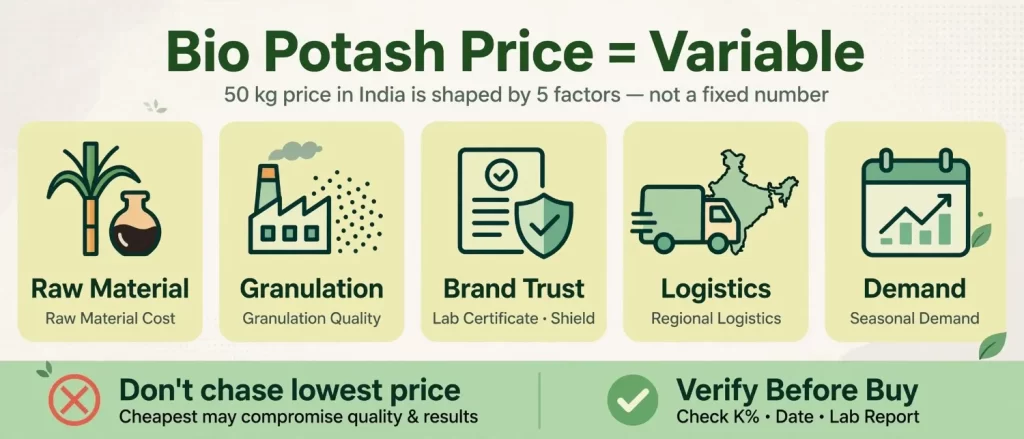
Ultimately, the bio potash 50 kg price in India is shaped by a combination of raw material cost, granulation quality, brand trust, regional logistics, and seasonal demand – not a single fixed number you can expect everywhere. Rather than chasing the lowest quoted figure, cross-checking potassium content, manufacturing dates, and lab certification will protect both your budget and your crop outcomes. If you are ready to compare verified, lab-tested options, a bio potash solution suited to your specific crop and soil conditions.