
Potash derived from molasses (PDM) is a Fertilizer Control Order-notified organic potassium fertilizer manufactured from the incinerated spent-wash ash of sugarcane molasses distilleries, carrying a minimum of 14.5% water-soluble K2O. First notified under FCO 1985 in 2009, PDM was formally brought under India’s Nutrient-Based Subsidy scheme from the Rabi 2022 season, with a subsidy of Rs. 345 per tonne fixed for 2024-25. It stands as a chloride-free, domestically manufactured alternative to imported Muriate of Potash (MOP), governed by specific quality parameters that every legitimately sold bag is required to meet.
If you have ever picked up a bag labelled “PDM Potash” at your local agri-input shop and wondered exactly what you were buying, you are not alone. This guide breaks down the regulatory identity of potash derived from molasses as an FCO-registered organic potassium fertilizer, where it is manufactured, what quality standards genuine bags must meet, and how to buy it with confidence rather than guesswork.
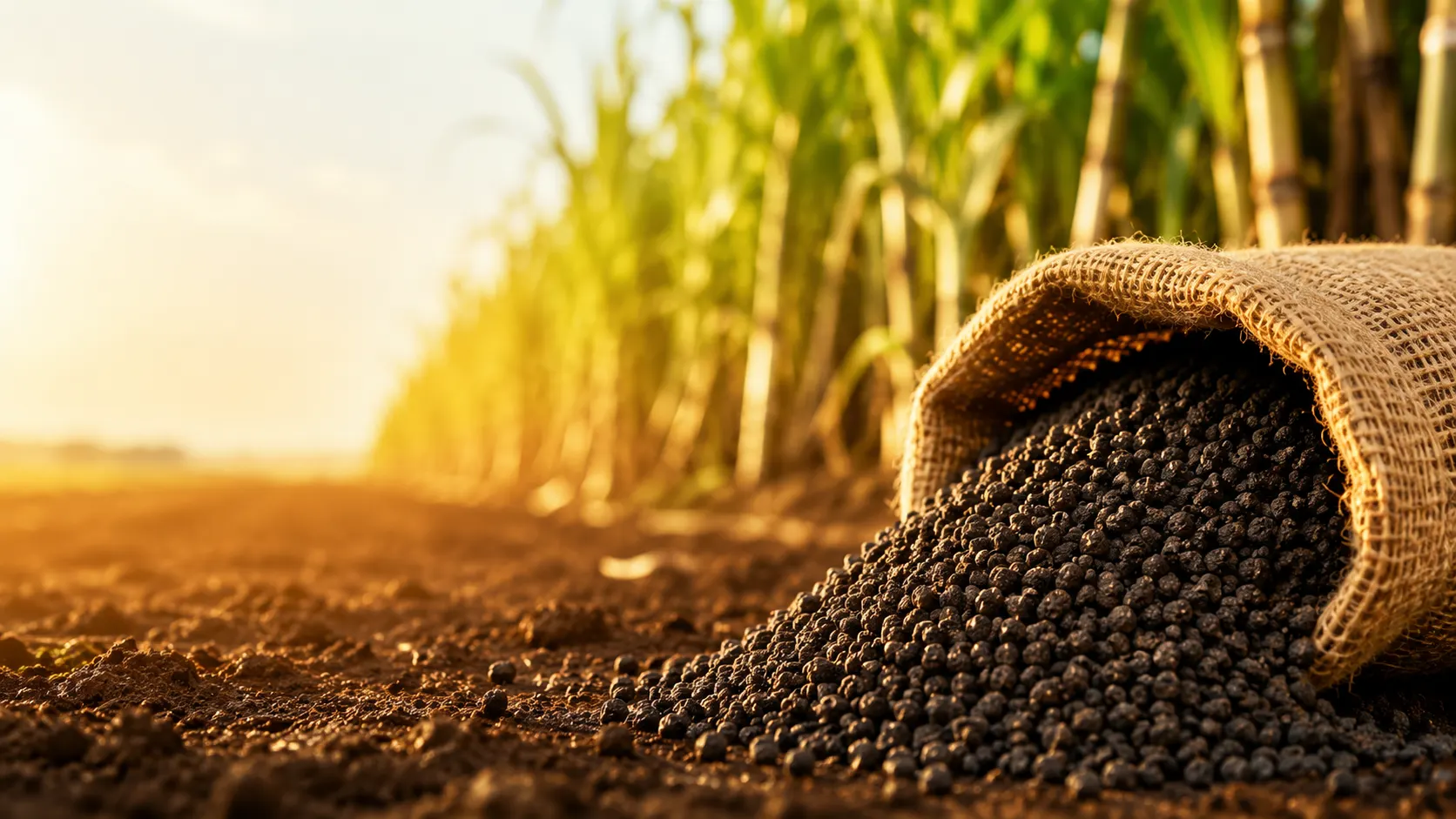
What is Potash Derived from Molasses? A Working Definition
Potash derived from molasses is the ash-based potassium fertilizer generated as a co-product of India’s sugarcane and ethanol distillation industry. Sugar mills crush cane and separate out molasses; distilleries then ferment that molasses into ethanol, leaving behind a nutrient-dense liquid residue called spent wash. When this spent wash is concentrated and burnt in incineration boilers, the resulting ash is rich in potassium salts. That ash is processed and granulated into the product farmers know as PDM.
Quick definition : Potash derived from molasses (PDM) is a granular, organic potassium fertilizer produced from the incinerated ash of distillery spent wash, a sugarcane molasses by-product. It contains a minimum 14.5% water-soluble K2O, is notified under the Fertilizer Control Order, 1985, and is eligible for India’s Nutrient-Based Subsidy scheme.
Quick Facts About PDM
| Attribute | Detail |
|---|---|
| Full form | Potash Derived from Molasses |
| Raw material source | Incinerated ash of molasses-distillery spent wash |
| Minimum K₂O content | 14.5% (water-soluble) |
| Physical form | Dark brown to black granules |
| Chloride content | Negligible / near-zero |
| Regulatory status | Notified under FCO, 1985 (since 2009) |
| Subsidy eligibility | NBS scheme, effective Rabi 2022; Rs. 345/tonne for FY 2024-25 |
| Typical application rate | 25-100 kg/acre, depending on crop and soil test |
From FCO 1985 to NBS 2022: The Regulatory Journey of PDM
Unlike many organic fertilizer claims in the market, potash derived from molasses is not a loosely defined product. According to a press release by the Press Information Bureau, Government of India, PDM was officially notified as a fertilizer under the Fertilizer Control Order, 1985 back in 2009, establishing baseline quality and labelling requirements more than a decade before it became a mainstream farming input.
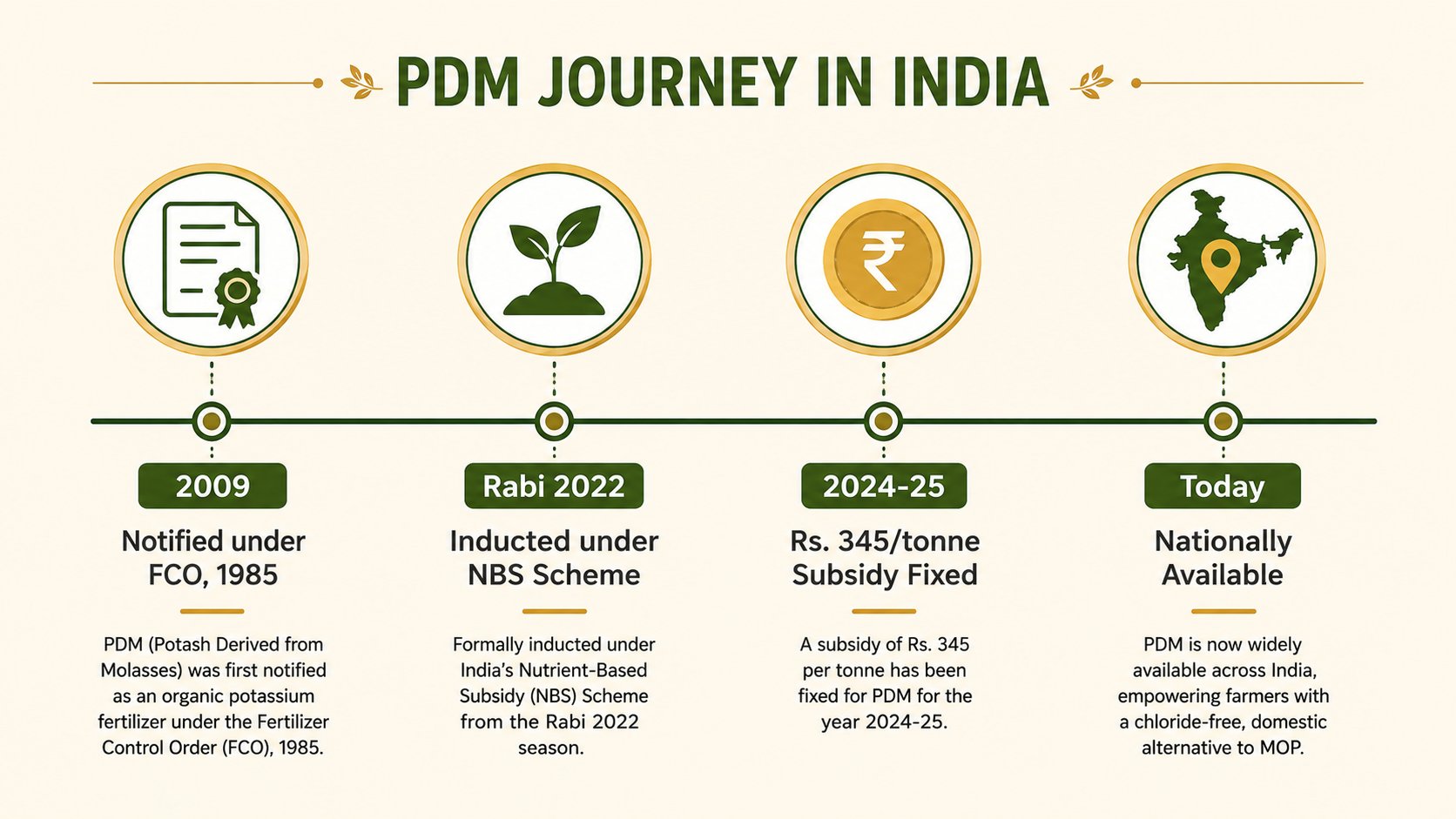
The real turning point for adoption came later. To incentivize wider uptake of this domestically produced potassium source, the government inducted PDM under the Nutrient-Based Subsidy (NBS) scheme starting from the Rabi 2022 cropping season. For the 2024-25 fiscal year, a subsidy of Rs. 345 per tonne has been fixed for PDM, directly lowering its landed cost for farmers relative to fully imported chemical potash.
This regulatory backing matters for a reason that goes beyond pricing. Potash and glauconite, the potassic mineral group, have also been classified as Critical and Strategic Minerals under the Mines and Minerals (Development and Regulation) Amendment Act, 2023, reflecting how seriously India now treats potassium self-sufficiency. Since the country still imports the overwhelming majority of its chemical potash requirement, primarily as MOP, PDM’s domestic, waste-to-value production model is a policy priority, not just an agronomic option.
The FCO Quality Parameters Genuine PDM Must Meet
Because PDM is regulated under FCO, manufacturers cannot simply grind up any potassium-bearing ash and sell it under this name. The following table summarises the parameters that legitimate, FCO-compliant PDM is expected to meet before it reaches a dealer’s shelf.
| Parameter | Requirement / Typical Standard |
|---|---|
| Water-soluble K₂O | Minimum 14.5% |
| Chloride content | Negligible, making it suitable for chloride-sensitive crops |
| pH reaction | Alkaline, typically in the 8.5-11 range |
| Granule size | Uniform granules, commonly in the 2-4.75 mm range for consistent spreadability |
| Physical form | Free-flowing dry granules, free from visible foreign matter |
| Labelling | Manufacturer name, FCO registration number, batch number, net weight, and K₂O content clearly printed on the bag |
Whenever you buy PDM, the label is your first quality checkpoint. A bag that omits the FCO registration number, the K2O percentage, or the batch number is not something you should trust with your season’s input budget.
Where is PDM Manufactured in India?
Because PDM production depends entirely on molasses-based ethanol distilleries operating alongside sugar mills, its manufacturing footprint closely tracks India’s sugarcane belts. Consequently, the states with the largest PDM production capacity are:

- Uttar Pradesh: India’s largest sugarcane-producing state, home to a dense concentration of integrated sugar-cum-distillery units.
- Maharashtra: A major cane-crushing and ethanol-distillation hub in western India, with several cooperative sugar mills running PDM production lines.
- Karnataka: Significant PDM output from sugar belts around Belagavi, Mandya, and Bagalkot.
- Tamil Nadu and Andhra Pradesh: Growing PDM manufacturing capacity tied to south Indian sugar and distillery clusters.
- Punjab and parts of Uttarakhand: Smaller but active production linked to regional cane processing.
If you farm outside these belts, do not assume PDM is unavailable to you. Since it is a nationally regulated, subsidy-eligible fertilizer, most state cooperative federations and private agri-input dealers now stock PDM sourced from these production hubs, even in regions that grow little or no sugarcane themselves.
How PDM Compares With Other Potash Sources
Farmers frequently ask how potash derived from molasses stacks up against the chemical and microbial potassium options already on the market. Here is a side-by-side view:
| Feature | PDM | MOP | SOP | Microbial Bio Potash |
|---|---|---|---|---|
| Source | Molasses distillery spent-wash ash | Mined mineral (imported) | Mined mineral (imported) | Bacterial culture (KSB) |
| K₂O Content | Min. 14.5% | ~60% | ~50% | Not a direct K source |
| Chloride | Negligible | ~45–47% | Negligible | N/A |
| Domestic Origin | Yes | No | No | Varies |
| NBS Subsidy | Yes, since Rabi 2022 | Yes | Yes | No (biofertilizer) |
| Mode of Action | Direct mineral K + soil conditioning | Direct, fast release | Direct, fast release | Solubilizes fixed soil K |
This distinction is worth remembering:
PDM is a direct, granular mineral fertilizer that supplies potassium to crops immediately after application. In contrast, microbial bio potash products do not add significant amounts of new potassium to the soil. Instead, they contain beneficial microorganisms that help release potassium already present in the soil but locked in insoluble mineral forms. Therefore, the two products serve different purposes and should be viewed as complementary tools
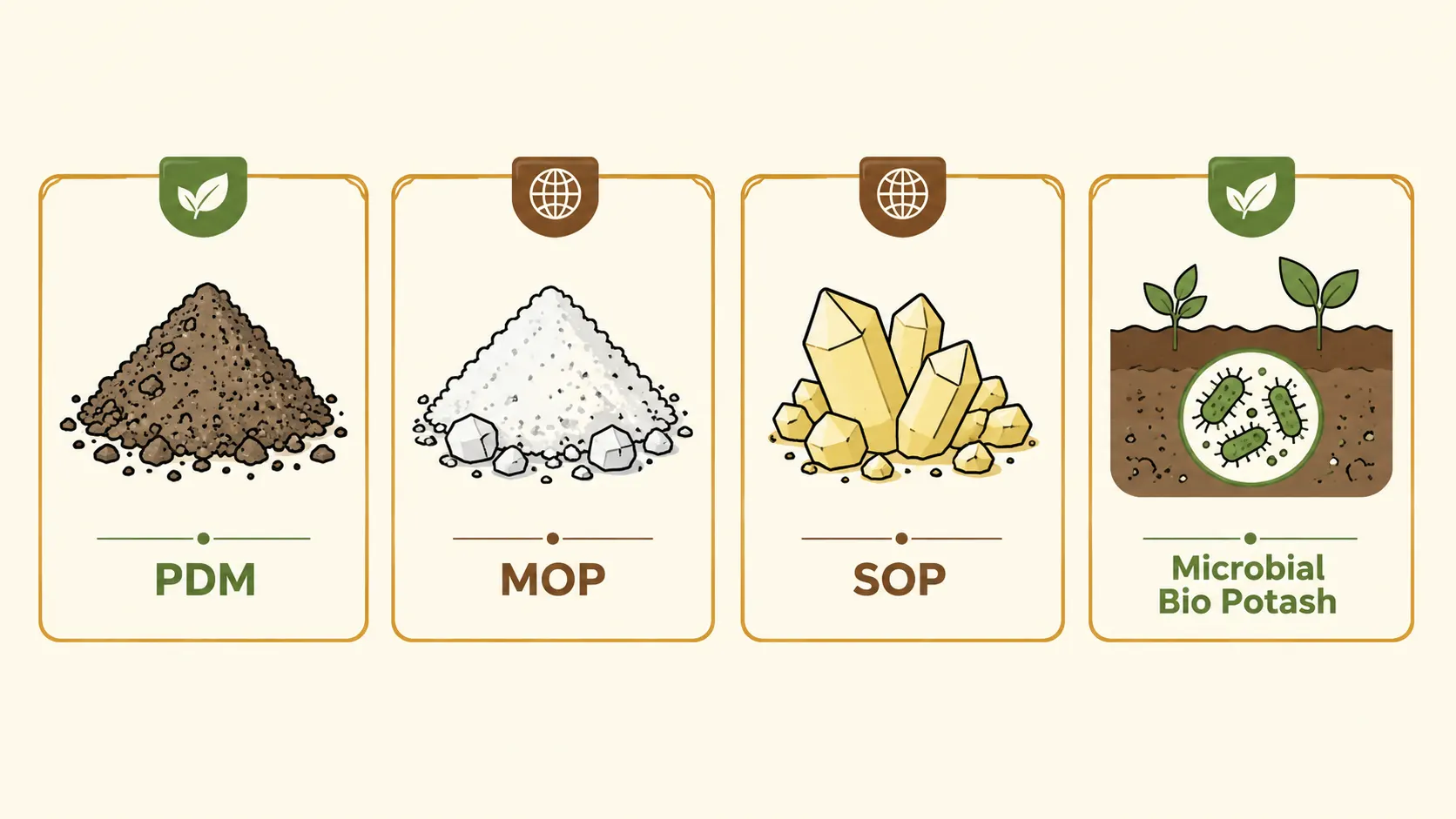
rather than direct substitutes. Confusing them can lead to incorrect purchasing decisions and may result in nutrient management practices that do not match the actual needs of the crop or soil.
Core Agronomic Benefits of Potash Derived from Molasses
Beyond its regulatory identity, PDM earns its place in Indian input programmes because of what it does in the field:
- Chloride-free potassium nutrition, well suited to sensitive crops like grapes, citrus, potato, and tobacco.
- Organic matter and secondary nutrients including calcium, magnesium, and sulphur, delivered alongside potassium in a single application.
- Improved crop quality, including better fruit sweetness, grain weight, and post-harvest shelf life.
- Reduced import dependency, since PDM is manufactured entirely within India from agro-industrial waste.
- Soil conditioning benefits that build over multiple seasons as organic residues support microbial activity.
For a full breakdown of application timing, crop-wise dosage, and step-by-step usage instructions, Uwike’s complete guide to bio potash fertilizer for Indian growers covers this ground in detail, while the Bio K fertilizer application guide walks through field-crop and home-garden dosing step by step.
How to Verify You Are Buying Genuine, FCO-Compliant PDM
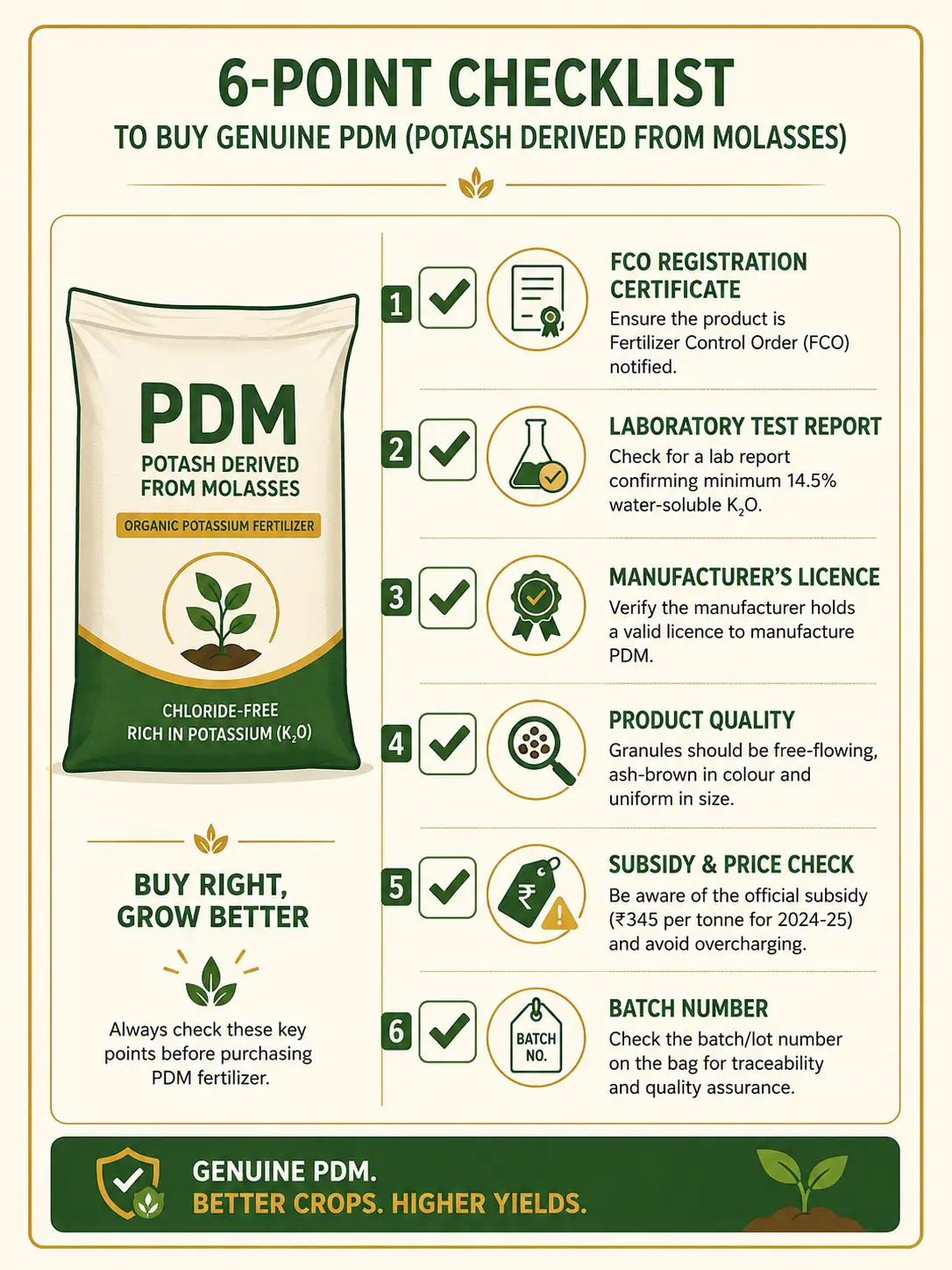
Because PDM’s popularity has grown quickly, so has the risk of mislabelled or diluted product entering informal supply chains. Before you buy, work through this checklist:
Ask for the FCO registration number printed on the bag, and note the manufacturer’s name against it.
Request the batch-wise lab analysis certificate confirming the water-soluble K2O percentage meets the 14.5% minimum.
Buy only from a licensed fertilizer dealer. Under FCO rules, fertilizer sale requires a valid dealer licence; ask to see it if you are unsure.
Check the granule consistency. Genuine PDM granules are relatively uniform in size and colour; excessive dust, uneven lumps, or visible foreign matter are red flags.
Be wary of prices that seem too low. Given input, processing, and transport costs, PDM priced dramatically below the regional market rate is worth double-checking before purchase.
Cross-check the batch details against the manufacturer if you have any doubt, particularly for large-volume purchases.
Common Mistakes Farmers Make When Buying PDM
Mistake 1: Assuming Every “Bio Potash” Product Is PDM
The Indian market carries both granular PDM and microbial bio-potash products under similar marketing language. They are not the same product and do not work the same way in the soil. Confirm which type you are purchasing before you factor it into your nutrient plan.
Mistake 2: Buying Loose or Unlabelled Stock
Loose PDM sold without proper bagging, batch numbers, or an FCO registration number offers no traceability if the product underperforms. Insist on properly labelled, sealed bags.
Mistake 3: Ignoring the Manufacturing Source
Since PDM quality can vary slightly between manufacturers depending on distillery feedstock and processing equipment, sticking with a consistent, reputable source season after season reduces variability in your results.
Mistake 4: Overlooking Storage Conditions at the Point of Sale
PDM granules are hygroscopic. If a dealer stores stock in a damp or poorly ventilated area, the product you buy may already be caked or degraded before it reaches your field.
Mistake 5: Skipping the Subsidy Paperwork
Because PDM is NBS-eligible, purchases through registered dealers are often reflected in subsidy records. Farmers who buy informally or without proper billing may miss out on the benefit of the Rs. 345 per tonne subsidy built into the pricing structure.
Expert Tips for First-Time PDM Buyers
- Start with a soil test. Confirm your field’s actual potassium status through your nearest Krishi Vigyan Kendra or the Soil Health Card portal before committing to a large PDM purchase.
- Buy a small trial quantity first from a new supplier before scaling up to your full seasonal requirement.
- Keep the bag label and purchase receipt for at least one full crop cycle, in case you need to raise a quality complaint.
- Compare landed cost, not just sticker price, once you factor in the NBS subsidy and transport from the nearest production hub.
- Pair PDM with compost or FYM at the time of basal application to improve microbial uptake and overall nutrient synergy.
Is Potash Derived from Molasses Right for Your Farm?
PDM tends to be a strong fit if any of the following apply to your operation:
- You grow chloride-sensitive crops such as grapes, citrus, potato, or tobacco, where MOP’s high chloride content is a genuine risk.
- You want to reduce reliance on imported, price-volatile chemical potash.
- Your soil could benefit from added organic matter alongside potassium nutrition.
- You are enrolled in, or eligible for, organic or natural farming transition programmes that favour agro-waste-derived inputs.
On the other hand, if your priority is the fastest possible correction of a severe, confirmed potassium deficiency, a blended approach using PDM alongside a measured dose of MOP or SOP, guided by your soil test, may deliver quicker results in the short term.
Frequently Asked Questions About Potash Derived from Molasses
Q1: What is potash derived from molasses (PDM) in simple terms?
Potash derived from molasses (PDM) is a granular organic potassium fertilizer made from the potassium-rich ash left over when distillery spent wash, a by-product of molasses-based ethanol production, is concentrated and incinerated. It carries a minimum of 14.5% water-soluble K2O and is registered under the Fertilizer Control Order, 1985.
Q2: Since when has PDM been eligible for government subsidy in India?
PDM was first notified under the Fertilizer Control Order, 1985 in 2009. It was formally inducted into India’s Nutrient-Based Subsidy scheme starting from the Rabi 2022 cropping season, with a subsidy of Rs. 345 per tonne fixed for the 2024-25 fiscal year.
Q3: How do I check if a PDM product is genuine and FCO-compliant?
Ask the dealer for the manufacturer’s FCO registration number, request the batch-wise lab analysis certificate confirming minimum 14.5% water-soluble K2O, check that the bag is labelled with the manufacturer’s name, batch number, and net weight, and avoid loose, unbranded, or unusually cheap PDM sold without documentation.
Q4: Which states in India manufacture potash derived from molasses?
PDM is manufactured wherever molasses-based distilleries operate alongside sugar mills, concentrated mainly in Uttar Pradesh, Maharashtra, Karnataka, Tamil Nadu, and parts of Andhra Pradesh and Punjab, since these states account for the bulk of India’s sugarcane crushing and ethanol distillation capacity.
Q5: Is potash derived from molasses the same product everywhere in India?
The manufacturing process and the minimum 14.5% K2O standard are consistent under FCO rules, but individual batches can vary slightly in organic matter, secondary nutrients, and granule quality depending on the distillery’s feedstock and processing equipment. Buying from an FCO-registered manufacturer with a current lab report reduces this variability.
Q6: Can PDM be sold by any fertilizer trader?
No. Like all fertilizers regulated under the Fertilizer Control Order, 1985, PDM can only be legally sold by dealers holding a valid fertilizer sale licence. Farmers should purchase only from licensed dealers who can produce this licence and the manufacturer’s registration details on request.
Making an Informed Choice on Potash Derived from Molasses
Potash derived from molasses has moved from a niche sugar-industry by-product to a government-recognised, subsidy-backed mainstream fertilizer option for Indian farmers. Understanding its FCO registration history, its NBS subsidy status since Rabi 2022, and the quality parameters a genuine bag must meet puts you in a far stronger position than simply picking up any product labelled “PDM” off a shop shelf. Combine that regulatory literacy with the practical buying checklist above, and you can add this domestically produced potassium source to your input programme with confidence rather than guesswork. For deeper guidance on Uwike’s full range of soil fertility and plant nutrition solutions, visit the Uwike blog resource library for more grower-focused reading.
Looking for the best quality potash derived from molasses for your next season? Explore Uwike’s bio potash granules and place your order today.